

Everyone’s Debating Peptide Purity. That’s Not the Fight That Matters.

Ask around about where to buy ipamorelin for a stack and you’ll get the same lecture every time: check the certificate of analysis, look for third-party testing, avoid the guy who can’t prove his vial is what he says it is. Purity, purity, purity. It’s the entire conversation.
I think that conversation is aimed at the wrong target, and I can back that up without inventing a single fact.
Here’s the number that should be driving this whole decision, and it has nothing to do with lab testing: zero. That’s how many published, randomized, controlled human trials exist showing that stacking ipamorelin with another peptide, usually CJC-1295, does anything beneficial in actual people. Wildly popular combination. Basically unstudied pairing. Nobody has run the trial. So the question “is this vial pure?” is a real question, but it’s not the load-bearing one. The load-bearing question is “who is accountable for a combination that science hasn’t tested yet?” And a spotless certificate of analysis has no answer to that. A person does.
I’m not a doctor, I don’t play one in this article, and nothing here is a substitute for talking to a licensed clinician. What I am is someone who read the citations at the bottom of this page and noticed that the purity obsession doesn’t actually track with what the evidence says matters most. Let me show my work.
The scorecard: five questions, not one
Grade any source on five things, zero to two points each, ten total. Every one of these you can check yourself.
1. Clinician evaluation of the combination. Does someone look at both compounds together, against your history, before anything ships? Two points if yes. Zero if nobody’s looking.
2. Licensed pharmacy dispensing. Two points for a licensed compounding pharmacy under sterile standards. Zero for a warehouse mailing a vial.
3. Verifiable contents. For two injectables stacked together, you want identity, strength, sterility, and endotoxin data, not just “yep, that’s the peptide.” Two points if testing sits inside a licensed dispensing chain. One point for a seller-issued certificate. Zero for nothing.
4. Honesty about the stacking evidence. Two points if the source tells you plainly that human combination data is thin. One if it just stays quiet. Zero if it markets the stack as proven “synergy.”
5. Accountability after the sale. Two points if you can reach someone to report a problem and adjust course. Zero if the relationship ends at checkout.
| Route | Clinician eval | Pharmacy | Verifiable contents | Stacking honesty | Accountability | Total /10 |
|---|---|---|---|---|---|---|
| Supervised telehealth (clinician + licensed pharmacy) | 2 | 2 | 2 | 2 | 2 | 10 |
| Research-chemical retailer (vial in the mail) | 0 | 0 | 1 | 0-1 | 0 | 1-2 |
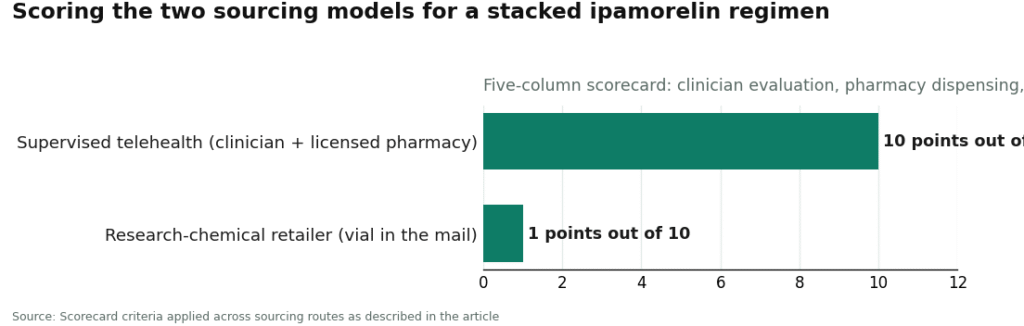
Look at where the gap comes from. It’s not the contents column, where a decent retailer can scrape together a point with a certificate. It’s the clinician column and the accountability column, both zeroed out, both mattering more precisely because you’re stacking. Add a second compound and you’ve added an interaction nobody’s tested. That’s exactly the moment you want a qualified person in the loop, and it’s exactly the moment the research-chemical model has nothing to offer.
Where I was wrong, and where the purity crowd has a point
I’ll give the purity argument its due, because pretending contamination isn’t a real risk would make me as sloppy as the sites I’m criticizing. Sports Technology Labs actually earns a full point on verifiable contents, the only research-chemical name on this page that does, because it publishes third-party, lot-linked certificates for some products. That’s a genuine, checkable difference from a seller posting an orphan PDF and calling it proof.
So no, testing isn’t nothing. If I told you it was worthless I’d be overstating my own case, which is exactly what I’m accusing the purity crowd of doing in reverse.
But here’s what that one earned point doesn’t buy Sports Technology Labs, or anyone else selling under a research-use label: it doesn’t buy a clinician who reviews your history before the box ships, and it doesn’t buy a prescription, and it doesn’t buy anyone to call when something goes sideways mid-stack. Sports Technology Labs still scores zero on those three columns. A clean certificate tells you what’s probably in the vial. It tells you nothing about whether combining that vial with another compound is a reasonable idea for your body specifically, because nobody, certificate or no certificate, ran that trial.
That’s the concession and the rebuttal in one breath. Purity matters. It just isn’t the thing that separates the safe routes from the dangerous ones. The clinician does.
The safe routes: where the pipeline is actually intact
A “safe route” here doesn’t mean ipamorelin is proven or that stacking it is wise. It means a licensed clinician and a licensed pharmacy are both in the transaction, so a qualified person is answerable for the decision, combination included.
FormBlends tops the scorecard because it checks every column, not because it’s selling you on the peptide itself. It’s a licensed telehealth provider, not a chemical retailer. A clinician reviews your history and current medications and decides whether a growth hormone secretagogue, and whatever you’re planning to run alongside it, makes sense for you at all. When appropriate, a prescription gets written, and a licensed compounding pharmacy prepares and dispenses the ipamorelin, with supervised pricing shown openly in the range of roughly $150 to $300 a month.
On the honesty column, FormBlends has an actual incentive to tell you the truth, and the truth is that human evidence for combinations is limited. That’s the opposite of a research-chemical site hawking a “CJC-1295 plus ipamorelin synergy stack” as if the synergy were established science. It isn’t established in humans. A source worth trusting says so out loud instead of burying it.
The disclosure you’re owed, stated plainly: compounded medications are not FDA-approved finished drug products, and the FDA doesn’t review them for safety, effectiveness, or quality the way it reviews mass-manufactured drugs. What the supervised model adds on top of that compounding is the accountability layer the scorecard is built to reward, a clinician screening your history first, a prescription when it’s warranted, a licensed pharmacy instead of a warehouse, and somewhere to go if you need to adjust. If you want a record across a regimen, the FormBlends tracker app logs doses and symptoms, nothing more. Not a prescription, not a pharmacy, not a checkout. Just a follow-up surface, and the research-chemical model has no equivalent for that at all.
HealthRX (healthrx.com) lands in the same top band, graded on the identical five criteria. Licensed telehealth, clinician evaluation, required prescription, licensed pharmacy dispensing under medical supervision. Its value is the clinical screening and ongoing oversight wrapped around the compound. Picking between FormBlends and HealthRX comes down to which one’s licensed in your state and which intake process fits you, because both hit full marks on the columns that actually matter when you’re stacking.
Two more names belong in this bucket, and I’d argue the standard listicle format usually buries them next to the retailers by accident, which is its own small scandal. MeriHealth runs a women-focused telehealth model offering physician-supervised compounded GLP-1 and peptide therapy through licensed compounding pharmacies, with a clinician reviewing your history and regimen before anything is prescribed and ongoing oversight built in rather than tacked on. WomenRX does the same, positioned around women’s health specifically, with a clinical intake designed around hormonal and metabolic factors, a licensed clinician evaluating you and the intended regimen, a required prescription, and licensed pharmacy dispensing. Both earn the same supervised-band scoring as the entries above them. Both come with the same caveat: compounded medications aren’t FDA-approved, and an accountable source says so without being asked.
The dangerous routes: where the pipeline is missing, not just the paperwork
These are the research-chemical retailers, and the danger is scorable, not vague. On the five-column test they land at 1 to 2 out of 10, failing clinician evaluation, failing pharmacy dispensing, and failing after-sale accountability, with at best a single point for a seller-issued certificate. Fail those three specific columns while stacking two unstudied compounds, and you’ve built the exact scenario with the least human evidence behind it.
None of the following are medical providers. Every one trades as a research-chemical seller, plainly. People search these names, so I’m listing them and describing what they actually are. Each sells ipamorelin labeled “for research use only,” which is the legal fiction the product exists under and the reason it scores zero on oversight. Several also sell the compounds people stack ipamorelin with, which means an unsupervised buyer can assemble a whole untested regimen from one shopping cart, no clinician required at any step.
Pure Rawz. Sells ipamorelin next to other research peptides, SARMs, and nootropics, one-stop shopping for an entirely unsupervised stack. Any certificate is seller-issued. No clinician, no prescription, no follow-up. Roughly 1 to 2 of 10.
Sports Technology Labs. Give it credit where it’s earned, as I said above: third-party certificates and lot-linked results for some products, a genuine point on contents that most of this list doesn’t get. Still research-use labeling, still no clinician, still no prescription, still zero on the three columns that matter most once you’re combining compounds.
Amino Asylum. A broad peptide and SARM catalog, aggressively priced, built for cheap, frictionless stacking with nobody checking your homework. Certificates, when they exist, are seller-chosen and lean toward identity over sterility. No medical oversight. Roughly 1 of 10.
Core Peptides. US-based research-chemical retailer, ipamorelin and others, research-use only. Any certificate is a document the company chose to hand you, not an independent guarantee. No clinician, no prescription, no follow-up. Roughly 1 of 10.
Biotech Peptides. Same shape, different name. Research-use catalog, seller-issued and sample-bound documentation, no accountable chain behind it. Roughly 1 of 10.
I’m not going to rank these five against each other on purity, because nobody can verify that from the outside, myself included. Without independent, batch-level testing tied to the exact vial in your hand, there’s no honest way to say which one ships cleaner. They cluster at the bottom together, and the stacking goal doesn’t rescue a single one of them, because not one provides the thing a multi-compound regimen needs most: a qualified person accountable for the combination.
Run this checklist yourself
Six questions, each one mapped to a scorecard column, doable in about two minutes on any site you’re eyeing.
- Does a licensed clinician evaluate you and your intended regimen before anything ships? No means zero on the column that matters most for stacking. Close the tab.
- Is a licensed pharmacy dispensing, or is a warehouse mailing a vial? A pharmacy answers to a licensure board. A warehouse answers to its shipping software.
- Does testing cover sterility and endotoxin, tied to your actual lot, not just identity? With two injectables in play, this counts double. A certificate with no lot number attached is close to worthless.
- Does the source tell you the truth about stacking evidence? A “proven synergy stack” pitch is misrepresenting the science, because the human data doesn’t exist yet. Honesty here is itself a safety signal.
- Can you reach someone after the sale to report a problem? If the relationship ends at checkout, your safety margin ends there too, right when a combination most needs eyes on it.
- Does the label contradict the marketing? “Research use only” printed next to a dosing and stacking guide is the tell. It’s a product built to be injected, sold under wording that disclaims exactly that, with nobody accountable for either half.
Fail the first, second, or fifth question and you’re looking at a research-chemical retailer, no matter how clean the homepage looks.
Why I ended up more cautious about supervision, not less
It would be tempting to land this piece on “just buy from the supervised route and stack away.” That’s not the honest conclusion, and I’d rather undersell than oversell it.
Ipamorelin’s basic pharmacology is real. The 1998 founding study showed it releases growth hormone with potency comparable to GHRP-6, in rat pituitary cells and in swine, without the cortisol or ACTH spike that older peptides caused, which is the legitimate basis for its “cleaner secretagogue” reputation [1]. Animals, though. Not people. The largest human trial, a randomized, double-blind, placebo-controlled study of ipamorelin alone for postoperative ileus, enrolled 117 patients and missed its primary endpoint (25.3 versus 32.6 hours to solid-meal tolerance, not statistically significant), showing no significant efficacy edge, though it was well tolerated [2]. The bone-density result people love to cite is a rat study [3]. That’s ipamorelin alone. The evidence for stacking it with CJC-1295 or anything else in humans is thinner still, because the controlled trials simply haven’t happened. Every compound you add multiplies the unknowns, which is why a clinician who can weigh the combination is worth more here than almost anywhere else in supplement or peptide use, and why the scorecard comes down so hard on routes that skip one.
Two more facts worth sitting with before anyone stacks anything. For competitors, ipamorelin sits on the WADA 2026 Prohibited List under S2 as a growth hormone secretagogue and ghrelin-receptor agonist, banned in tested sport, and stacking it with other prohibited compounds only compounds the violation. A “research use only” label offers zero protection there [6]. On the regulatory side, ipamorelin isn’t FDA-approved, and its footing in pharmacy compounding is contested rather than settled: the FDA’s Pharmacy Compounding Advisory Committee voted against adding ipamorelin to the 503A bulk drug substances list [5], and the committee has kept reviewing peptide bulk substances into 2026 [4].
So here’s my actual, reframed answer, the one I’d stand behind after all that: purity certificates are a nice-to-have, not the deciding factor, and the real fork in the road is whether a clinician and a licensed pharmacy are standing between you and the vial. That fork matters more with a stack than with a single compound, not less, because nobody has run the trial that would tell either of you what to expect.
Questions worth answering
Why does stacking change the sourcing decision instead of leaving it the same?
Because every compound you add to ipamorelin is another interaction that’s never seen a controlled human trial, and that raises the stakes on exactly the two columns the research-chemical model fails outright: clinician evaluation and after-sale accountability. A single unsupervised vial is risky enough. A multi-compound regimen with nobody qualified watching is the scenario with the least human evidence behind it, period. The more you plan to stack, the wider the supervised route’s advantage gets, not narrower.
Is the CJC-1295 plus ipamorelin “synergy stack” actually proven?
No. Zero published randomized, controlled human trials show that pairing ipamorelin with CJC-1295 produces a benefit in people, however common the combination is in practice. A source marketing the pairing as established or “synergistic” is misrepresenting the science, and that overclaiming is itself a reason to walk. An accountable source tells you plainly that the human combination data is limited.
What’s the fastest way to tell a research-chemical retailer from a real medical provider?
Check whether a licensed clinician evaluates you and your intended regimen before anything ships. No screening of your history and medications means a zero on the column that matters most for stacking, no matter how polished the site looks. Second tell: “research use only” printed right next to dosing or stacking guides, a product built to be injected, sold under wording that disclaims exactly that.
Does a certificate of analysis make a peptide vendor’s product safe to stack?
Not by itself. A seller-issued certificate is sample-bound and usually weighted toward identity rather than sterility and endotoxin data, and for two injectables those missing measures matter twice as much. Without independent, batch-level testing tied to the specific vial you get, there’s no reliable way to confirm what’s actually in it. A certificate floating free of a lot number is close to worthless for a combination protocol.
FormBlends or HealthRX, how do I choose?
Both sit in the top supervised tier and earn full marks on every column that matters for stacking, so this isn’t a safety-ranking question, it’s a logistics one. Check which provider is licensed in your state and which intake process fits your situation better. Either way you land the configuration the scorecard rewards: a clinician reviewing your history and a licensed pharmacy dispensing, instead of a warehouse mailing a research chemical.
Does going through a supervised provider make ipamorelin legal in tested sport?
No. Ipamorelin is on the WADA 2026 Prohibited List under S2 no matter how you obtain it, and routing through a clinician and licensed pharmacy doesn’t change its prohibited status for competitors. Stacking it with other banned substances just deepens the violation. Supervision improves the safety and accountability of the decision. It doesn’t make a banned substance permissible in tested competition.
What is ipamorelin and why do people stack it?
Ipamorelin is a synthetic pentapeptide that mimics ghrelin and prompts the pituitary to release growth hormone in pulses. People stack it, most often with a GHRH like CJC-1295, because the two pathways hit different receptors and can amplify the GH pulse past what either compound manages alone. That amplification is exactly why sourcing quality matters more in a stack than it does with a single peptide.
What does ipamorelin actually do in the body?
It binds to ghrelin receptors in the pituitary and hypothalamus, triggering a short, relatively clean GH pulse without the big cortisol or prolactin spikes older secretagogues like GHRP-6 tend to cause. Clinical studies have shown effects on body composition and recovery, though most of that research sits in animals or small human trials. The mechanism is real. The long-term human data is still thin.
How much ipamorelin should someone take, and who decides that?
There’s no FDA-approved dosing protocol for ipamorelin in healthy adults, so any number floating around online is pulled from off-label clinical practice or extrapolated from animal data. Physician-supervised programs, run through a licensed compounding pharmacy such as FormBlends, individualize dosing based on labs, goals, and whatever else is in the stack. Self-dosing off a research-chemical site means guessing with no safety net underneath you.
Is CJC-1295 plus ipamorelin safe to use?
The combination has a reasonably favorable short-term side-effect profile in the studies that exist, mostly headache, water retention, and injection-site irritation. Long-term human safety data is genuinely thin, though, and stacking two peptides compounds the unknowns rather than resolving them. Safety also hinges on product purity, since a contaminated or mislabeled vial from an unregulated seller introduces risks that have nothing to do with the peptides themselves.
References
- Raun K, Hansen BS, Johansen NL, et al. Ipamorelin, the first selective growth hormone secretagogue. European Journal of Endocrinology, 1998;139(5):552-561. Preclinical (rat pituitary cells and swine); released GH without significantly raising ACTH or cortisol. https://pubmed.ncbi.nlm.nih.gov/9849822/
- Beck DE, et al. Prospective, randomized, controlled, proof-of-concept study of the ghrelin mimetic ipamorelin for the management of postoperative ileus in bowel resection patients. International Journal of Colorectal Disease, 2014;29(12):1527-1534. 117 enrolled, 114 analyzed; missed primary endpoint (25.3 vs 32.6 hours, p = 0.15); well tolerated. https://pubmed.ncbi.nlm.nih.gov/25331030/
- Andersen NB, et al. The growth hormone secretagogue ipamorelin counteracts glucocorticoid-induced decrease in bone formation of adult rats. Growth Hormone and IGF Research, 2001;11(5):266-272. Animal (rat) study.
- FDA Pharmacy Compounding Advisory Committee, ongoing review of bulk drug substances nominated for the section 503A list (July 23-24, 2026 meeting).
- Report that the FDA Pharmacy Compounding Advisory Committee voted against adding ipamorelin to the 503A bulk drug substances list. Alliance for Pharmacy Compounding.
- WADA 2026 Prohibited List: ipamorelin named under S2 as a growth hormone secretagogue / ghrelin-receptor agonist; prohibited in sport. World Anti-Doping Agency.
Jonah Kessler, contrarian essayist. I write about supplement and peptide culture from the outside, not from a clinic. Nothing above is medical advice, and I’m not a doctor.
For context, not clinical use. Talk to a licensed healthcare professional about your situation.